

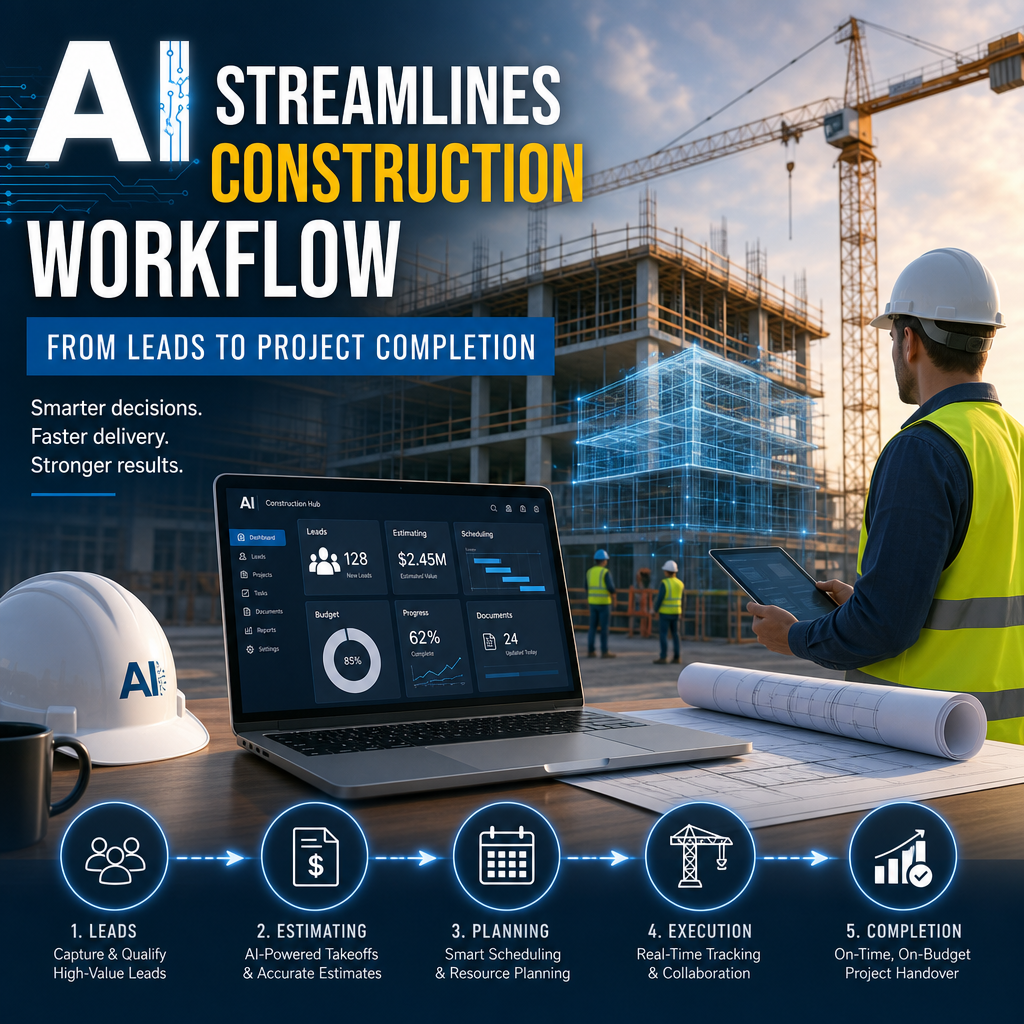
AI Streamlines Construction Workflow from Leads to Project Completion
From Leads to Project Completion: How AI Streamlines the Entire Construction Workflow
Construction companies are under constant pressure to win more jobs, manage tighter schedules, control costs, and keep clients happy. At the same time, teams are dealing with labor shortages, supply chain disruptions, and more complex projects than ever before.
That’s where AI streamlines the entire construction workflow in a practical, measurable way. From the first lead to final handoff, artificial intelligence can help construction businesses work faster, make better decisions, and reduce costly mistakes.
AI in the Early Stages: Turning Leads into Qualified Opportunities
Winning new work starts long before ground is broken. In the preconstruction phase, AI can help companies respond faster and prioritize the right opportunities.
Smarter lead tracking
Instead of manually sorting through inquiries, AI tools can analyze incoming leads and identify which ones are most likely to convert. This helps sales and estimating teams focus their time on high-value prospects.
Faster bid evaluation
AI can review historical project data, client behavior, and market trends to support bidding decisions. Contractors can better assess:
- Project size and scope
- Likelihood of award
- Profit potential
- Risks tied to timing or complexity
This means teams spend less time chasing weak leads and more time pursuing projects that fit their strengths.
Planning and Estimating with Greater Accuracy
Estimating is one of the most important parts of any construction workflow. Small errors here can lead to major budget issues later.
Data-driven cost estimates
AI tools can analyze past projects to improve cost forecasting. By comparing labor, materials, equipment, and subcontractor pricing, the system can suggest more accurate estimates based on real-world patterns.
Better risk prediction
AI can flag unusual pricing, missing scope items, or schedule conflicts before a bid goes out. This helps estimators avoid underbidding or overlooking hidden costs.
More efficient takeoffs
Digital takeoff tools powered by AI can scan plans, detect building elements, and measure quantities more quickly than manual methods. That saves time during the estimating phase and reduces the chance of human error.
Project Scheduling and Resource Management
Once a project is won, the next challenge is keeping everything on track. AI can help project managers build more realistic schedules and allocate resources more effectively.
Improved scheduling forecasts
Construction timelines are often affected by weather, labor availability, permit delays, and material lead times. AI can review historical data and current conditions to predict potential delays before they happen.
Smarter labor and equipment planning
By analyzing crew availability, jobsite progress, and equipment use, AI can suggest better resource allocation. This reduces downtime and helps teams avoid overbooking or shortages.
Real-time adjustments
If a delivery is delayed or a task falls behind, AI can recommend revised schedules and highlight the downstream impact. That allows managers to react quickly instead of waiting for problems to spread.
Streamlining Communication Across Teams
Construction involves many moving parts, from owners and architects to subcontractors and field crews. Miscommunication can lead to rework, delays, and frustration.
Centralized information flow
AI-powered platforms can organize project updates, documents, RFIs, submittals, and change orders in one place. This makes it easier for everyone to access the latest information.
Automated updates and alerts
Instead of relying on manual follow-ups, AI can send reminders about deadlines, missing documents, or approval bottlenecks. These small automation features keep communication flowing and reduce missed steps.
Better collaboration
When everyone works from the same data, it becomes easier to coordinate tasks and resolve issues early. That leads to fewer misunderstandings and smoother execution.
Improving Jobsite Performance and Safety
The construction site is where planning meets reality. AI is increasingly being used to monitor jobsite activity and support safer, more efficient operations.
Safety monitoring
AI-enabled cameras and sensors can detect unsafe behavior, equipment issues, or restricted-area violations. This helps supervisors identify hazards before accidents occur.
Progress tracking
By comparing site photos, drone footage, or scan data with the project schedule, AI can measure work completed versus planned progress. This gives teams a clearer view of whether a project is on target.
Quality control support
AI can help spot defects, missing components, or installation issues early in the process. Catching these problems sooner reduces rework and keeps the project moving.
Controlling Costs and Reducing Waste
Profit margins in construction can be thin, so controlling waste matters at every stage.
Materials management
AI can predict material needs more accurately, helping teams order the right quantities at the right time. This reduces overordering, storage problems, and jobsite waste.
Budget monitoring
AI tools can compare actual costs against estimates in real time and flag overspending. Project leaders can then correct course before small variances become major losses.
Fewer delays, lower costs
When delays are identified early and decisions are based on data, projects are less likely to run over budget. That benefits both contractors and clients.
From Completion to Future Growth
AI doesn’t stop helping when the project is finished. The data collected during construction can be used to improve future projects.
Post-project analysis
Teams can review performance data to see what worked, where delays happened, and which estimates were most accurate. These insights improve future planning and bidding.
Stronger customer relationships
Faster communication, fewer mistakes, and better project outcomes all lead to higher client satisfaction. That can result in repeat business and referrals.
Continuous improvement
Over time, AI helps construction firms build a smarter workflow based on real project history rather than guesswork. Each completed job makes the next one more efficient.
A More Connected Construction Workflow
Construction is a complex process, but it doesn’t have to be a fragmented one. When used well, AI streamlines the entire construction workflow by connecting sales, estimating, scheduling, execution, and closeout into a more intelligent system.
The result is not just faster work. It’s better work: more accurate bids, smoother coordination, safer jobsites, tighter cost control, and stronger project delivery from start to finish.
For construction firms looking to stay competitive, AI is becoming less of a luxury and more of a practical advantage.